
5 Sustainable Business: Connecting People, Planet, and Profit
Connecting People, Planet, and Profit
Shane Schvaneveldt
Learning Objectives
Understand the Triple Bottom Line framework of sustainable business (economic, environmental, social dimensions)
Explain the business case for sustainable business practices
Understand the life cycle and supply chain perspectives on a product’s sustainability
Understand the major environmental and social issues facing business and supply chains
Explain how stakeholder trust is formed and how greenwashing undermines trust
Identify how different business functions are involved in sustainable business
Every dollar spent is a vote for the kind of world you want
to live in. Every business decision shapes that world.
Introduction
Caleb Goode didn’t know what to make of it. He liked his work as a purchasing manager at IntelliHome Systems (IHS), a Utah-based company that specializes in smart home technology systems. However, just now he was asked to “wear a second hat” by joining the company’s new sustainability team – the 3P’s Team. It was all part of a new strategic initiative announced by the CEO, Olivia Shepherd. While IHS was reasonably consistent in turning a profit, it had never been known for environmental or social initiatives. Now, that was about to change. Caleb remembered the CEO’s words: “We will be a company that doesn’t just make a product, but also a promise. A promise to our customers, employees and community, and to the world we live in. We will rethink how we operate, innovate, and create lasting value for everyone, and show that profit and purpose can go hand-in-hand.”
What Is Sustainability?
Caleb knew that he would have a lot to learn. He was relieved that the team’s first meeting started with the basics, where he learned that, at its heart, sustainability is about “meeting the needs of the present without compromising the ability of future generations to meet their own needs”. That’s the classic definition from the U.N. Brundtland Commission, and it is the definition of sustainability most commonly adopted by businesses in the U.S. and around the world. Sustainability: Meeting the needs of the present without compromising the ability of future generations to meet their own needs
How about the sustainability team’s “3P’s” nickname? That was discussed at the team’s first meeting, too. For businesses, sustainability is often framed around the “Triple Bottom Line.” The conventional, single bottom line is Profit. Of course, financial profit is needed for reinvestment in the business and to compensate shareholders for their investment. However, there are two more bottom lines to keep track of: People (social responsibility) and Planet (environmental stewardship). The “3P’s” and Triple Bottom Line framework recognizes that these three areas are interconnected and crucial for long-term success.
Caleb found it helpful to think about sustainability like this: If you keep spending money (financial capital) like there’s no tomorrow, eventually you will run out and face bankruptcy. If a business keeps using up natural resources (natural capital) or exploiting its workers and communities (human capital) without regard for the long-term, it’s essentially doing the same thing. It’s a short-sighted strategy that is not sustainable and leads to eventual breakdown of not just one P but affects all three.
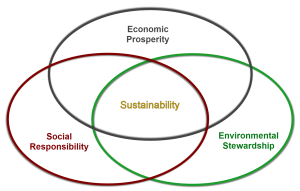
To better understand things, Caleb started making a simple list of what’s involved in the three bottom lines. The economic bottom line was easy. After all, companies have lots of experience thinking about their financial performance. The environmental and social bottom lines took more thought. What kinds of things would you look at to know if your company was performing better or worse? Eventually, Caleb came up with several ideas shown in Table 5.1.
| Economic (Profit) | Environmental (Planet) | Social (People) |
|---|---|---|
| Qty of products, services produced
Labor costs Equipment, materials, inventory Sales revenue Profit margin Return on investment Economy-building practices ________________________ Economic Performance |
Materials, water, energy consumptionEmissions to air, water, soilChemicals, toxicsWaste generationLand use impacts Biodiversity impacts Nature-restorative practices ________________________ Environmental Performance |
Employee health, safety
Fair hiring, wages Human rights Consumer protection Community partnerships and Transparency Stakeholder-supportive practices __________________________ Social Performance |
Why Should Business Care About Sustainability?
For the next meeting of the 3P Team, Caleb was assigned some homework: to report in more detail on the “business case” for sustainability. In other words, what is the business rationale for IHS to adopt more sustainable business practices. Here’s what Caleb found out:
- Resource Scarcity and Cost: Many resources we rely on (oil, fresh water, rare earth metals) are limited. As they become scarcer, their prices go up. Businesses that depend heavily on these resources without finding alternatives are taking an operational and financial risk.
- Regulatory Pressure and Cost: Local and national governments impose regulations to protect society at large. Think of labor laws, pollution limits, and waste disposal rules. Companies that do not comply can face fines and operating restrictions, all of which are costly and hurt reputation. Companies that proactively use clean technologies and avoid hazardous materials in their processes and products can reduce regulatory costs and get ahead of future regulations.
- Efficiency and Cost: Materials and energy are expensive. Reducing waste and becoming more resource efficient not only cuts operational costs but also helps the planet. That’s a clear win-win.
- Innovation: Pursuing environmental and social goals can challenge companies to rethink how they go about their business. Often, this drives innovation of new technologies, new products and even new markets.
- Employee Engagement: People are attracted to work for companies where they can feel purpose and are fairly treated. They become more engaged, productive, and loyal, all of which drive better business outcomes, too.
- Revenue: Products and services that meet environmental and social needs can increase their sales. This is not just for sustainability-focused customers, but also for the broad majority of customers who prefer a product that performs well and is, by the way, better for health, communities and the environment.
- Brand Reputation: Consumers want to buy from companies that share positive values. A company seen as an environmental villain or labor exploiter risks losing customers, talented employees, and investor confidence.
- Risk Management: Many business risks relate to environmental and social issues, all the way from resource scarcity, cost and disruption, to regulatory risks, health/safety risks, and reputational risks. These can have significant financial consequences, even extending to losing the firm’s “societal license to operate” if it loses the goodwill of the communities in which it operates. Proactive sustainability practices help to mitigate these risks.
What Are Key Sustainability Issues for Business?
Caleb’s report on the business case for sustainability went so well that he was asked to do more: to identify the key environmental and social issues for IHS to work on. He created a summary of his findings to report at the next 3P Team meeting.
Life Cycle and Supply Chain Perspectives
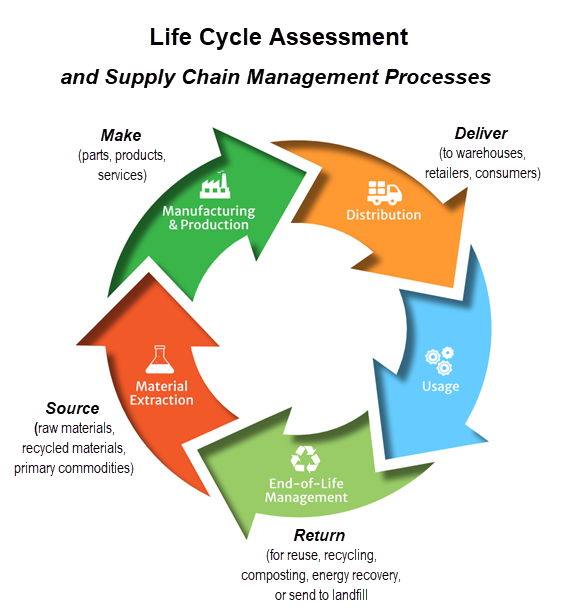
The first thing Caleb realized is that the environmental/social impacts of a company and its products do not start and stop at the company’s doors. They are generated in all phases of a product’s life cycle and along its supply chain, as shown in Figure 5.2. With the tool of Life Cycle Assessment (LCA), we use systems thinking to systematically identify the impacts that occur in raw materials extraction and processing, product manufacturing, distribution, customer usage, and finally the product’s end-of-life management. Supply chain management processes cover this full life cycle: sourcing materials, making products/services, delivering to customers for customer usage, and returning products/materials for their next use.
Major Environmental and Social Issues
As for the major environmental/social issues to consider during a product’s life cycle, Caleb identified the following:
Energy
Energy is needed for processing materials, making products, transporting them, and supporting all aspects of the company. Customers also consume energy when they use the product or service. When a business reduces its energy consumption, it directly benefits from reduced operational costs. Also important is the energy source. Clean, renewable energy sources like solar and geothermal have the least impact on human health and the environment, while fossil fuel energy from coal and natural gas contributes the most to air pollution and climate change.
Water
Businesses can impact water resources through pollution or excessive consumption. Water is used to grow or process materials like cotton, paper pulp and metal ores. It is also consumed in manufacturing and service processes, office facilities, data centers (for cooling), facility landscaping, and by consumers when they turn on a dishwasher or wash a T-shirt. Reducing water consumption cuts operational costs and risks.
Chemicals, Toxics, Heavy Metals
Some of the chemicals used in products and processes can be harmful to the health of employees, customers, communities and ecosystems. When dealing with such materials, companies must follow strict handling and hazardous waste disposal regulations, but even then, problems occur. Even better, companies can adopt green design principles to develop non-toxic alternatives.
Air Pollution
The major sources of air pollution in the U.S. include transportation (vehicles that burn gasoline or diesel), power generation (particularly from coal), and certain manufacturing processes such as oil refining, steel production and cement production. Businesses can reduce air pollution by implementing stricter pollution-control technologies, reducing energy consumption, using electric vehicles, and switching to clean renewable energy sources.
Waste Management
Material waste is generated in all phases of a product’s life cycle. Mines have tailings dumps, coal power plants have coal ash ponds where the lead and mercury settle in the bottom, manufacturing plants have various material wastes, logistics providers and retailers may have pallet and container waste, consumers end up with packaging waste and end-of-life products. Most of this material is “wasted” by going to the landfill, or often to open pits or open burning in developing economies. More than 2 billion metric tons of municipal solid waste are generated globally every year (and increasing), but less than 20% of it is being recycled in some way. Several types of waste are of particular concern due to their environmental impacts, including plastic waste, food waste, and e-waste from end-of-life electronics and computers.
Biodiversity, Deforestation, Land Use
Climate Change
Various factors influence the earth’s climate over time. What is alarming in recent decades is the rapid increase in overall global warming and extreme weather events such as intense rainstorms and flooding. These changes are linked to the atmosphere’s increasing concentration of greenhouse gases (primarily carbon dioxide and methane) emitted from fossil fuel production and consumption, along with certain industrial and agricultural practices and land use changes such as forest depletion. While some view that there is confusion on this issue, the warming effect of these greenhouse gases was well established by scientists in the 1800s and by internal research reports by Shell, Exxon and the fossil fuel industry in the 1960s-1990s. The question of what to do about it has since become politicized. Regardless of politics, reductions in energy consumption make financial sense and reduce a company’s “carbon footprint”. Switching to clean, renewable energy sources reduces pollution and negative health effects. On an equalized non-subsidized basis, solar power has emerged as the lowest cost energy source to build, generate and use.
Challenge Question #1:
Caleb’s neighbor, who works for a financial services company, learned of Caleb’s work on the 3P’s Team and told him, “Well, your team wouldn’t have much to do at my company. We don’t make or ship products and so we don’t have environmental impacts.”
How would you respond to the neighbor? Does a financial services firm impact the environment? In what ways?
Approaches for Managing Sustainability in Business
From Linear to Circular Business Systems
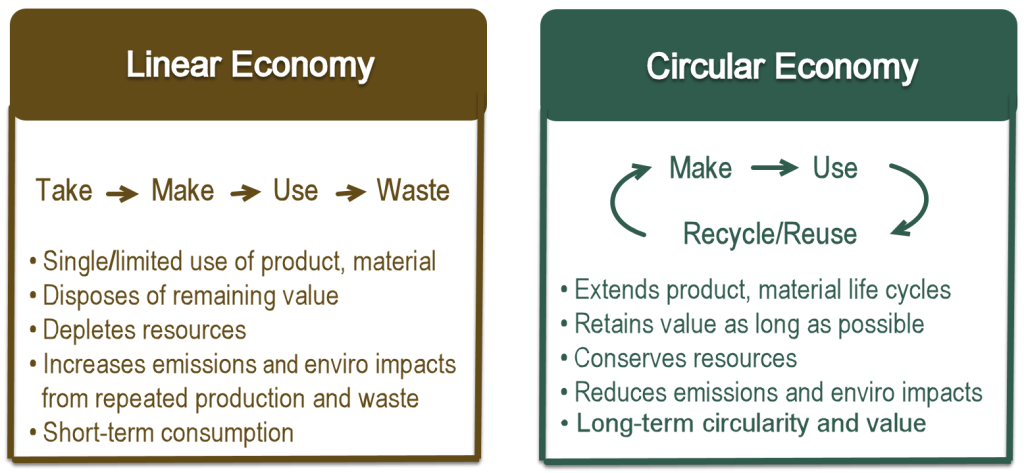
Caleb looked closely at the End-of-Life Management phase in the life cycle assessment diagram (previous Figure 5.2). He noticed that there were two major directions possible for end-of-life: 1) toward disposal and landfill waste; or 2) toward reuse and recycling or returning safely to nature in the case of composting. “Waste is material in the wrong place”
As shown in Figure 5.3, in the first situation (linear system), products and materials flow one-way to a dead end in the landfill. In the second situation (circular system), products and materials are reused, remanufactured, or recycled to keep them in their highest value state for as long as possible. To adopt more circular approaches, companies are rethinking their business. They may redesign products to make them easier to reuse or recycle, and they may redesign their business systems and partnerships so that end-of-life products are easier to collect and process for their next usage.
Challenge Question #2:
Caleb paused to think. For various items (including packaging) that he had used that day, he wondered: Which of them fit into the linear approach and which of them fit into the circular approach? What would need to happen with business and supply chain systems to be able to adopt a more circular approach?
Think of five to ten items that you have used in the past day. How would you answer these same questions?
Stakeholder Trust and Greenwashing
Earlier in Chapter 3 on the human link in supply chain management, we learned about the Stakeholder Trust Model (see below) and that stakeholders form trust based on how they perceive your organization’s 1) ability, 2) benevolence and 3) integrity. This model directly applies to sustainable business practices, too.
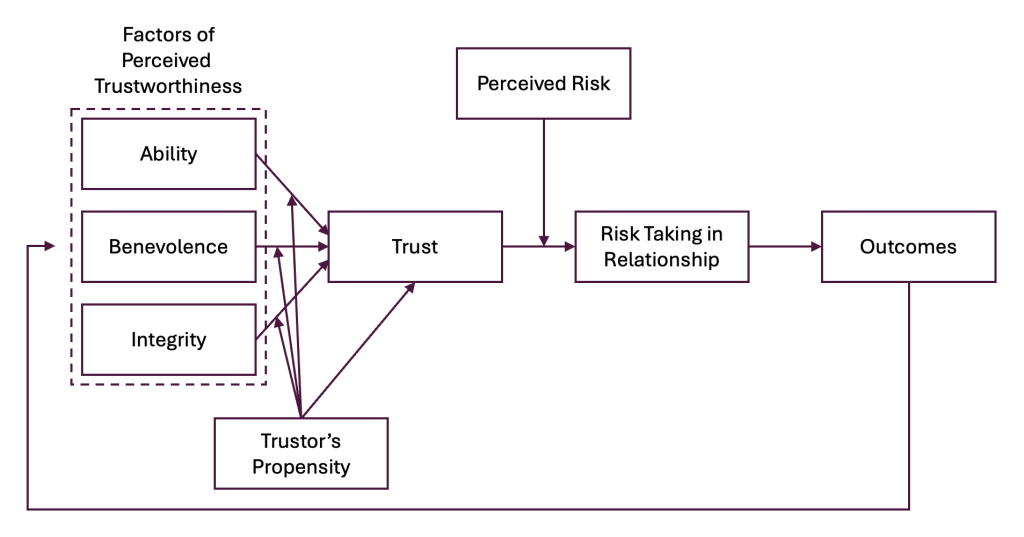
Companies that care about more than just their own short-term interests, but also people and the planet, are perceived as having more Benevolence. Also, a company that improves the sustainability of its operations and supply chain will have less risk, be more resilient, and have more Ability to meet the needs of customers and other stakeholders over the long-term. Finally, think about Integrity. We say that a person has integrity if they do what they say. It is the same for companies and sustainability – are their words and their actions aligned? Public relations and marketing communicate the company’s values and environmental/social responsibility. It is in the company’s operations and supply chain where most of the action takes place to deliver on those promises.
What happens if a company’s sustainability communications and actions do not align? For example, if the company paints a greener picture of itself and its products than the reality? In such cases, the company commits “greenwashing”, which erodes the integrity and trustworthiness of the company. As examples of greenwashing, Volkswagen programmed 10 million of its “Clean Diesel” cars to cheat on emissions tests, resulting in much more air pollution than claimed. This led to over $33 billion in fines and settlements, but even most costly may be the long-term loss of brand reputation and consumer trust. As another example, Keurig marketed its single-use coffee pods as eco-friendly and recyclable. However, the reality is that most local recycling facilities cannot accept or process the small cups made with #5 polypropylene plastic. From this, Keurig was fined $10 million for deceptive advertising and lost brand trust. Much better for organizations is to improve their environmental performance and be transparent about their progress.
Which Parts of the Business Are Involved in Sustainability?
Caleb knew that sustainability involved much more than putting out recycling bins. Still, he was surprised at all the ways that IHS’s departments were involved in sustainability. Looking at the table created by the 3P Team (Table 5.2), it is clear that sustainability is very cross-functional. No wonder the sustainability team had members from across the business.
| Business Function | Key Sustainability Practices | Business Benefits |
|---|---|---|
| Product Development | Materials selection; elimination of toxics; energy consumption; packaging; design for repair, reuse, recyclability | Innovation; increased revenue; improved health and safety; reduced liability and risk; improved brand reputation |
| Procurement & Suppliers (Source) |
Ethical sourcing of materials and services; supplier assessment and support; traceability through supply chain; collaborative supplier relationships | Risk mitigation; cost savings; improved brand reputation; innovation |
| Operations (Make) |
Renewable energy-powered facilities; reduction of energy, water and material consumption: reuse/recycling; elimination of toxics and emissions in products and processes; environmental management systems | Cost savings; increased productivity; improved health and safety; risk mitigation; increased resilience for the business |
| Logistics (Deliver, Return) |
Fleet electrification; efficient distribution networks and warehousing; packaging and waste reduction; renewable energy-powered warehouses; reverse logistics of end-of-life products, materials | Cost savings; reduced emissions; improved health and safety; improved efficiency; faster delivery |
| Human Resources | Employee recruitment; employee training and education related to sustainability; health and safety protection | Increased employee engagement and retention; improved health and safety; reduced risk; strengthened company reputation |
| Marketing & Consumer Engagement | Cause-related marketing; eco-labels; transparency in sustainability communications; consumer education; eco-friendly packaging; sustainability-focused market segments; | Improved brand reputation; consumer trust and loyalty; market differentiation; increased sales and revenue |
| Finance & Accounting | Budgeting and cost analysis; financial risk analysis for environmental and social factors; carbon accounting and reporting; sustainability ratings and indexes; sustainable and socially responsible investment analysis | Improved internal decision-making; attraction of investors; improved risk management; enhanced transparency and stakeholder trust |
Moving Forward with Sustainability
Caleb Goode looked back on his time with the 3P’s Team. He felt positive and engaged working on issues that made a difference. Along the way, he had learned a lot:
- Sustainability and the Triple Bottom Line – Creating shared value for shareholders and other stakeholders in terms of economic, environmental, and social performance.
- Business case for sustainable business practice – The 3P’s don’t have to compete with each other, but can all contribute to long-term success of the organization.
- Life cycle and supply chain perspectives – The importance of taking a systems view of products and processes since environmental and social impacts occur all along the supply chain and most impacts are not visible from looking at just the product itself.
- Major environmental and social issues for business – Ranging from energy, water, waste management and climate change, to transparency, workplace health/safety and forced labor.
- Stakeholder trust and greenwashing – Trust is essential for success. Painting a picture of your company and its products that is greener than the reality erodes the trust of customers and other stakeholders.
- Sustainability across the company – Sustainability involves all departments of a business, with operations and supply chain as areas where a major difference can be made.
Looking ahead, Caleb hoped to continue working on the sustainability team. At the same time, he realized that IHS’s sustainability efforts would be at their best when sustainable business practices were integrated into the company’s normal routines and a special sustainability team was no longer needed. At that point, he hoped that IHS will have met CEO Olivia Shepherd’s vision and become “a company that doesn’t just make a product, but also a promise. A promise to our customers, employees and community, and to the world we live in.”
Case Study A: IntelliHome Systems – Energy and the Triple Bottom Line
Caleb Goode felt a surge of accomplishment as he sent out his recommendation to the executive team of IntelliHome Systems (IHS). Based in Utah, IHS specializes in smart home technology systems. It was not that long ago that their CEO, Olivia Shepherd, had announced the strategic initiative for sustainability, and had challenged the company to “rethink how we operate, innovate, and create lasting value for everyone, and show that profit and purpose can go hand-in-hand.”
After several months as a member of IntelliHome’s new sustainability team, Caleb had worked up a proposal for their first major project. He felt that it met the team’s expectations for a project that would be reliable and proven, and that would contribute to all three aspects of IHS’s Triple Bottom Line – Economic, Environmental, and Social.
What was Caleb proposing? A 4-megawatt solar array and geothermal project for the company’s main facilities – the corporate headquarters and nearby manufacturing and distribution facilities. The project’s solar array would generate electricity and include some energy storage. The geothermal piping to be installed deep around the buildings and under parking lots would be used to boost the energy efficiency of their facility’s heating/cooling up to 65% on a continuous 24/7/365 basis.
This clean energy project is particularly noteworthy in a state like Utah, where the energy grid still relies heavily on fossil fuels like coal and natural gas. As Caleb explained in his proposal, the project would not only provide long-term economic benefit to IHS but also serve as a public statement about the company’s commitment to reducing its carbon footprint and contributing to air quality improvement in the region.
Put yourself in Caleb’s place, and respond to the following questions.
Discussion Questions
- If implemented, how would the solar panel and geothermal project for IntelliHome impact the company’s Triple Bottom Lines?
- Besides facility heating/cooling, are there other ways that IntelliHome is consuming energy?
- It has been said that energy conservation is the greatest, cheapest, and cleanest “energy source” available. What is meant by that?
What role should energy conservation play in IntelliHome’s plans? - What is meant by a company’s carbon footprint? How does the solar and geothermal project affect IHS’s carbon footprint?
In what other ways could IHS reduce its carbon footprint? - Besides energy, what other environmental aspects could IHS work on? How?
Case Study B: IntelliHome Systems – Ethical Sourcing
Time for celebration! Caleb’s proposed solar and geothermal project had been approved!
Now, Caleb and his purchasing team were tasked with a straightforward objective: source the most efficient and cost-effective solar panel system. (A facilities team was working on the geothermal part.) After two months of research and negotiation, they settled on a major global supplier, “SolarTech Global.” The panels met all technical specifications, and the company offered very competitive pricing and a short lead time to installation and operation. Also, SolarTech appeared to be the right kind of supplier for a next step in IHS’s sustainability strategy – developing a mini solar and battery storage add-on that would power a customer’s smart home system even when the grid went down.
With the solar panel contract only days away from signing, Caleb gasped out loud as he read a report just received from an international human rights organization. It showed how companies like SolarTech Global, while reputable themselves, source solar panel components from Chinese suppliers, who in turn source critical solar materials like polysilicon from a network of sub-suppliers in China’s far western Xinjiang region.
The report provided extensive evidence, including satellite imagery and eyewitness testimonials, alleging that some of the labor used by these sub-suppliers is provided through a state-run program of forced labor involving the indigenous Uyghur population. Since 2017, over a million Uyghurs have been held in mass detention camps and prisons for “re-education” and “vocational training” to suppress their ethnic identity and autonomy. Factories inside these camps and elsewhere in the country use forced labor from Uyghurs and other Muslim minorities to produce goods and materials ranging from cotton textiles to polysilicon. China has denied such reports.
Caleb immediately alerted the CEO, Olivia Shepherd, for a meeting. The revelations create a profound conflict for IntelliHome. On one hand, moving forward with the SolarTech Global contract would allow the company to achieve its publicized environmental goal on time and under budget. And it could set the foundation for an ongoing supply relationship with SolarTech for the new mini solar add-on product under development. Both would be significant wins for the company’s strategic initiative. On the other hand, engaging in business that could be linked to human rights abuses would expose IHS to severe reputational damage, potential legal risks (like the U.S. Uyghur Forced Labor Prevention Act), and a breach of its own ethical principles. The next-best supplier was 25% more expensive and had a nine-month longer lead time. The added cost and delay would jeopardize the solar panel project and disappoint everyone.
Caleb felt tense as he faced Olivia. How should they navigate this complex situation? After all, the solar panel materials might not actually come from a facility using forced labor, and even so, would anyone else even know about such issues?
Discussion Questions
- What is IntelliHome’s responsibility in this situation?
- Identify the key stakeholders in this case. How might each of them be involved and impacted?
- What are the basic options available to IHS? Analyze each option’s risks and rewards.
- What other issues of ethical concern might exist in the supply chain of a company like IHS?
Is it possible for a company to ensure that its supply chain is truly ethical, particularly in today’s global economy? What approaches could a company take, and what are the limitations? - What role, if any, do individual consumers play in a company’s supply chain practices?
Media Attributions
- TBL spheres © Shane J. Schvaneveldt is licensed under a CC BY-NC-ND (Attribution NonCommercial NoDerivatives) license
- LCA SCOR © Shane J. Schvaneveldt
- Linear Circular Economy © Shane J. Schvaneveldt is licensed under a CC BY-NC-ND (Attribution NonCommercial NoDerivatives) license
- Stakeholder Trust Model © Mayer, R. C., Davis, J. H., & Schoorman, F. D.