
12 Effective Interprofessional Communication and Collaboration
Laura K. Garner-Jones
Chapter 12 Overview
- Define interprofessional communication
- Discuss why effective interprofessional communication is essential
- Understand basic interprofessional elements and factors that influence interprofessional communication
- Review the importance, benefits, and enablers of Interprofessional Collaborative Practice (IPCP)
- Apply elements of the TeamStepps evidence-based framework
Introduction
Interprofessional communication is defined as the interaction between healthcare professionals, with the primary goal of achieving positive health-related outcomes (Street & Mazor, 2017). Because of the complexity of patient care, no single profession can manage the full scope of a patient’s diagnosis, needs, and treatment. Instead, interprofessional teams manage different aspects of healthcare delivery (Kermani et al., 2022). Each healthcare discipline, with its unique set of skills and knowledge, contributes to the patient’s overall care. With the involvement of many disciplines, it is challenging for healthcare providers to align goals, share knowledge effectively across disciplines, make appropriate decisions (Yune et al., 2020), and improve healthcare and patient outcomes (IPEC, 2023). Unfortunately, communication and teamwork across healthcare disciplines are not always effective, and the resulting gap can be a liability in patient care.
Interprofessional Communication Basics
-
- During interprofessional communication, verbal exchanges may occur between two or more team members, usually in person or by telephone.
- Written communication in the interprofessional context commonly includes documentation notes in a patient’s chart, such as progress notes, physician orders, medication administration records, diagnostic reports, referral letters, and discharge notes. Other examples may include emails and, more recently, texts.
- Non-verbal communication in the interprofessional context involves conveying meaning and interpretation through body language, including facial expressions, eye contact, body position, and gestures. It is important to be aware of your body language and ensure that it aligns with your verbal language.
To communicate respectfully with colleagues and within interprofessional teams, nurses should utilize the following elements (Table 12.1).
Table 12.1 – Effective Interprofessional Communication Elements
| Element | Description |
|---|---|
| Assertiveness | Showing confidence in oneself is assertiveness. Nurses who are assertive are more likely to build effective communication among healthcare team members and can improve patient care (Nakamura et al., 2017). An assertive nurse also advocates for patients until their concern is addressed. Assertive nurses are a necessity for patients who are unconscious, nonverbal, or have no advocate at their side, as they must speak up as the voice of the patient. Using assertive communication is also an effective way to resolve problems with patients, coworkers, and healthcare team members. |
| Courtesy | Being courteous in healthcare communication is vital. Courtesy refers to the practice of being polite, respectful, and considerate when interacting with patients, their families, and colleagues. It involves using polite language and maintaining a friendly and professional demeanor. These actions can build trust and place the patient at ease. By maintaining qualities of politeness and friendliness, the nurse conveys continuous acceptance of the patient and interest in discussing the patient’s feelings and concerns. Nurses often encounter patients who are not courteous; however, nurses should always be courteous to their patients. Nurses who are courteous in all communication encounters are more likely to deliver safe and effective care to their patients (Sibiya, 2018). |
| Empathy | Empathy is the ability to recognize, understand, share, and validate another person’s feelings. Empathy involves showing understanding of another’s situation or perspective (Sussex Publishers, 2025). Research has demonstrated that when health care teams communicate with empathy, there is improved patient healing, reduced symptoms of depression, decreased medical errors (Morrison, 2019), improved patient outcomes and satisfaction (Babaii et al., 2021), and better engagement, compliance, and a more positive attitude toward recovery (Bas-Sarmiento et al., 2019). |
| Listening | As discussed in Chapters 8 & Chapter 9, listening is one of the most important skills a nurse can master. Healthcare providers must actively listen; otherwise, they will not be effective team members. |
| Resolution | In health care, resolution involves reaching a point where both parties involved in the communication feel satisfied and understood, and that their objectives have been achieved. Effective resolution contributes to clear understanding, improved relationships, and the achievement of desired goals. Resolution when adverse events occur includes healthcare providers discussing, through clear, structured communication, what went wrong and how to prevent recurrence. |
| Trustworthiness | Nursing has been considered the most trusted profession since the 1990s, when the Gallup poll on most trusted professions was first conducted (Gaines, 2023). Nurses are considered honest in their words and actions. They are trusted to deliver honest, compassionate care, providing education and answering questions with patience. Ensure that you are honest and trustworthy in all you do and say, both with patients and colleagues. |
| Understanding | Communication is most effective if all messages received are understood. When healthcare team members do not verify their understanding with one another, patient care suffers. Patients are more likely to follow directions provided during an educational session if the information is supplied in a way the patient readily understands. If the patient receives the communication in multiple forms, such as verbal, written, and electronic, they will likely better understand the message. A patient who does not understand the directions given to them is less likely to obtain positive health outcomes. |
| Use of Names and Titles | Nurses should respect the professionals they work with on the healthcare team and use their correct names and titles. Nurses should also ask patients what they prefer to be called—by name, title, and pronouns —doing so helps establish a positive patient-provider relationship. |
Factors Influencing Interprofessional Communication
Several factors can influence interprofessional communication in either positive or negative ways, thereby affecting healthcare professionals and patient outcomes. The factors affecting interprofessional communication can be divided into three main categories: those related to the physical environment, those related to the context, and those related to the communication styles of the people involved.
-
- Physical: You will often work in environments that are sometimes noisy and involve many moving parts, including patients, families, and multiple members of interprofessional teams. In addition to people, there may be beeping machines and overhead announcements. You should be aware that this can cause sensory overload.
- Context: Interprofessional communication in healthcare environments occurs in complex settings that involve a high volume of information and dynamic, high-acuity clinical situations. It can be very intense, with life-threatening conditions, death, uncertainty, fear, and anxiety, which can lead to work overload. This context can also influence the dynamic nature and intensity of interprofessional conversations. The hierarchical relationships within interprofessional teams, as well as power imbalances or perceptions of power, can also influence how individuals communicate and interpret conversations.
- Styles: Each group of healthcare professionals has its own communication style, which may not align with those of other healthcare professionals. For example, nurses are often taught to be descriptive and embed narrative elements in their communication. This descriptive style capitalizes on a comprehensive and storied approach. Other healthcare professionals, such as physicians and pharmacists, are taught to communicate more concisely and efficiently. As you can imagine, these two communication styles may not always align, so it is essential to reflect on how to tailor your communication to the person or group you are speaking with, while still conveying your point of view as a nurse.
Because these factors can impact the quality and effectiveness of communication among healthcare professionals, it is essential to identify common challenges and explore practical strategies to address them. Table 12.2 presents examples of ineffective interprofessional communication and strategies to address each one.
Table 12.2: Ineffective Interprofessional Communication and Effective Strategies
|
Example |
Effects |
How to Manage This Type of Communication |
|---|---|---|
| Disrespectful Communication:
Physical Therapist: “It’s 11 am already!” [shakes head in disapproval] “Goodness gracious, you haven’t got her out of bed yet? What’s wrong with you?” |
Demoralizes and demeans another person. Although there may be a reason the patient was not helped out of bed, the nurse may feel disempowered and choose not to share the information.
|
The nurse could respond by saying, “It is probably better for you to inquire about the reasons that I have not gotten the patient out of bed. Your communication is disrespectful and disregards the current situation with Mrs. Hart. Would you like to know what is going on?”Alternatively, the physical therapist, who was initially disrespectful, could have engaged in a discussion that is guided by inquiry instead of blame, and said: “I noticed Mrs. Hart is not out of bed yet. How can I help?” |
| Failure to Communicate Concern:
Nurse: “The patient’s BP is 140/88.” Physician: “Okay.” |
The nurse stated a finding, but did not indicate or emphasize their concern. Thus, the physician did not recognize the need to be concerned or engage in a dialogue. Failure to communicate one’s concerns can negatively affect patient outcomes. |
When communicating, it is essential to express your concerns and ensure the individual you are discussing them with understands their importance.For example, the conversation could be modified such that the concern is acknowledged, and they engage in a discussion about the plan of care:Nurse: “The patient’s BP is 140/88. This is out of the ordinary for this patient; their baseline BP is 100/60. I have a serious concern about the high BP, and I think we should intervene.”Physician: “That is quite a jump. Is the patient’s pain well-controlled?” |
| Failure to Communicate a Rationale for an Action or Decision:
Nurse: “Let’s try putting the patient in the prone position.” Patient Care Technician: “You want us to roll the patient onto their abdomen.” Nurse: “Yes.” Patient Care Technician: “I think that will be difficult.” |
Neither of these professionals provides a rationale for their action or decision. As a result, neither professional understands the other’s perspective. |
When communicating, it is important to provide a rationale for your actions and decisions.For example, the conversation could be modified so that a person’s rationale is clearly identified, as such: Nurse: “Let’s try putting the patient in the prone position. Some recent research has suggested that this can improve respiratory function for severe respiratory distress that is not responding to other interventions.”Patient Care Technician: “I am concerned about rolling the patient onto their abdomen with all of the tubes and wires. Do you have any suggestions?” Nurse: “If you are open to it, I can grab one more person, and we can do it as a team. What do you think?” |
| Incomplete or Unclear Communication or Miscommunication:
Charge Nurse: “Can you help Ms. Di Lallo with her breakfast?” Patient Care Technician: “Yes” Charge Nurse: “She’s at table 1.” Patient Care Technician: [walks over to the patient], “Hi, Ms. Di Lallo, are you ready for your breakfast?” Patient: “Yes, can you please pass me my coffee?” Patient Care Technician: [passes Ms. Di Lallo her coffee]. Charge Nurse: “Oh, hold on! I forgot to mention that they need their liquids thickened first.” |
This unclear communication about the patient’s diet led to a near miss. Miscommunication, unclear communication, or incomplete communication can result in errors in patient care, with serious consequences for their health. |
When communicating, it is essential to include all pertinent information to ensure safe and effective care. All healthcare professionals need to clarify any communication shared.For example, the conversation could be modified by ensuring that all required information is communicated:
Charge Nurse: “Can you help Ms. Di Lallo with her breakfast?” Patient Care Technician: “Yes” Charge Nurse: “Great, she’s at table 1. Ms. Di Lallo has dysphagia, so you need to make sure all her fluids are thickened and follow the dysphagia diet protocol. The thickener should be on her tray. Do you have any questions?” Patient Care Technician: “No, I’m aware of the dysphagia diet protocol and will monitor Ms. Di Lallo during her meal.” |
| Ineffective Conflict Resolution:
Nurse: “Mr. Pink said he does not feel he is ready to be discharged, and I agree.” Respiratory Therapy: “I think I’m able to determine when Mr. Pink can be discharged, considering I’ve been working with him for 6 months, and you just met him last week.” Nurse: “I think we need to talk to the whole team.” |
The communication is ineffective because healthcare providers disagree about the patient’s plan of care. They are not focusing on the context or on explaining their reasoning in terms of the patient’s needs. They are focusing on their own opinions rather than a person-centred perspective and an evidence-informed approach.
|
In the event of a disagreement, healthcare providers must effectively explain their reasons within the context of person-centred care and evidence-informed approaches. It’s always important to use effective conflict resolution strategies.For example, the conversation could be modified as: Nurse: “Mr. Pink said he does not feel he is ready to be discharged. I agree with him because he has no support system in place to help him with his activities of daily living at home.”Respiratory: “I believe he is physically ready to go home, but you bring up a good point. Let’s put together a plan for home care.” Nurse: “Great.” |
Interprofessional Collaboration and Collaborative Practice (IPCP)
Healthcare has faced numerous challenges in delivering quality care over the past 50 years. The population is older, more diverse, medically complex, with a higher prevalence of chronic disease requiring multiple specialty providers, a greater reliance on technology and innovation, and uncoordinated delivery systems. Collaborative practice can improve the delivery of care through a concerted effort from all members of the healthcare team and leaders throughout the organization. Interprofessional collaboration is an indispensable part of nursing practice. The American Nurses Association (2021, p. 110) defines collaboration as “working cooperatively with others, especially in joint intellectual efforts, in a way that includes collegial action and respectful dialogue.”
In 2003, the Institute of Medicine (IOM), now the National Academy of Science, Engineering, and Medicine (NASEM), released the report Health Professions Education: A Bridge to Quality. In this groundbreaking document, the IOM emphasized the importance of HCPs working together interprofessionally. The IOM (2003, p. 54) detailed that team members should integrate their observations, expertise, and decision-making to coordinate, collaborate, and communicate with one another to optimize patient care. These concepts are collectively known as Interprofessional Collaborative Practice. The IOM (2015) also has stated, “No single profession, working alone, can meet the complex needs of patients and communities. Nurses should continue to develop skills and competencies in leadership and innovation and collaborate with other professionals in health care delivery and health system redesign…All healthcare providers must be prepared to work collaboratively in clinical practice with a common goal of building a safer, more effective, and patient-centered healthcare system.“
Interprofessional Collaborative Practice (IPCP) is critical for managing complex care, coordinating and responding to multiple patient needs, delivering care across various settings, and improving patient safety (Goulding et al., 2020). Other patient benefits include enhanced access to healthcare, reduced fragmentation, improved overall quality, lower costs, and better patient outcomes (WHO, 2010). IPCP also benefits HCPs and healthcare organizations. Professionals and organizations can expect a decrease in caregiver conflict, staff turnover, clinical error rate, mortality, and medical costs, as well as an increase in patient and caregiver satisfaction and patient compliance. Additionally, collaborative practice strengthens health systems, improves family health, improves infectious disease, assists with humanitarian efforts, and improved response to epidemics and noncommunicable disease (WHO, 2010).
Watch this TedX video about collaboration in healthcare.
Collaboration Enablers and Barriers
Morgan et al. (2015) conducted a literature review examining the elements of interprofessional collaboration in primary care settings. Two key facilitators of interprofessional collaboration are the availability of a joint meeting time for communication and having adequate physical space. Collaboration among healthcare professionals also requires leadership and planning, common goals, and a “teamwork” atmosphere. Choi & Pak (2007) identified eight major concepts of teamwork and formulated them within the acronym “TEAMWORK,” then discussed a range of enablers and barriers that affect collaboration success (Figure 12.1). The main takeaways include a commitment to working together toward a common goal, effective communication and collaboration, and taking the initiative to identify and resolve team conflicts.
Figure 12.1 – Promoting Behaviors and Barriers in “Teamwork”

TeamSTEPPS
TeamSTEPPS® is an evidence-based framework for optimizing team performance across the healthcare system. It is a mnemonic standing for Team Strategies and Tools to Enhance Performance and Patient Safety. The Agency for Healthcare Research and Quality (AHRQ, 2023), in collaboration with the Department of Defense, developed the TeamSTEPPS® framework as a national initiative to improve patient outcomes by improving teamwork skills and communication.
TeamSTEPPS® improves safety and the quality of care by:
-
- Producing highly effective medical teams that optimize the use of information, people, and resources.
- Increasing team awareness and clarifying team roles and responsibilities.
- Resolving conflicts and improving information sharing.
- Eliminating barriers to quality and safety (AHRQ, 2023)
Designed to improve healthcare outcomes, TeamSTEPPS® equips healthcare providers with actionable strategies for better collaboration. It utilizes evidence-based training and resources to reshape workplace culture. Ultimately, these teamwork tools ensure safer patient experiences while simultaneously lowering staff stress and improving job satisfaction (AHRQ, 2023). Key skills healthcare providers need to master to be an effective member of a team:
-
- Communication: information is clearly and accurately exchanged among team members
- Team Leadership: maximize team effectiveness by ensuring that information is shared, actions are understood, and teams have the necessary resources
- Situation Monitoring: actively scanning and assessing situations to gain information or understanding, or maintain awareness
- Mutual Support: understanding of other team members/disciplines responsibilities and workload so that team members’ needs are anticipated and supported.
Communication Skills and Tools
Communication is the first skill of the TeamSTEPPS® framework. It is defined as a “verbal and nonverbal process by which information can be clearly and accurately exchanged among team members” (AHRQ, 2023). All team members should use communication skills and tools to ensure accurate interprofessional communication.
SBAR
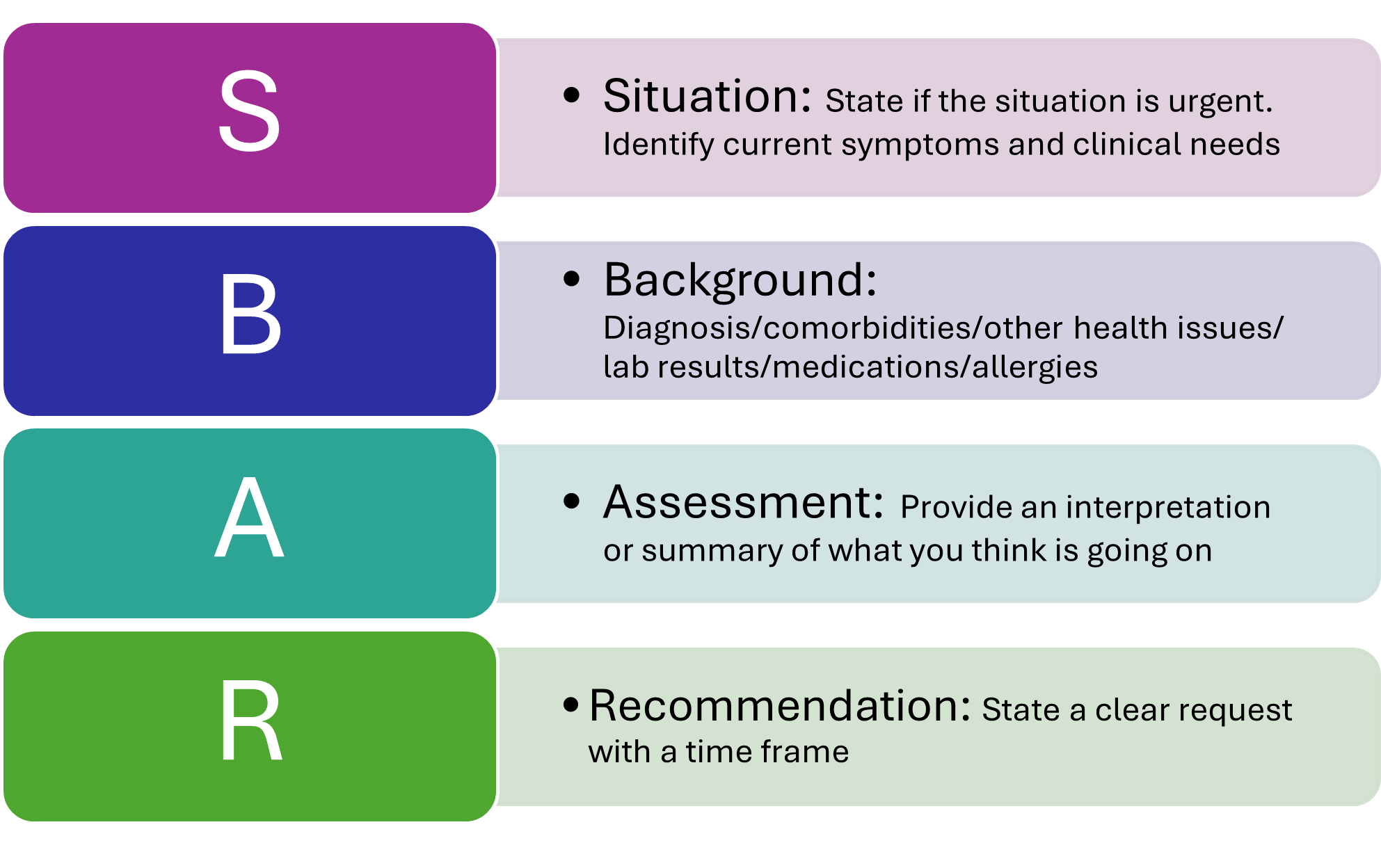
The SBAR tool is a common communication tool that facilitates effective verbal communication when discussing a patient with another healthcare professional or during handover. It provides a framework for communication that is focused, concise, and complete. SBAR (Figure 12.2) is an acronym that stands for Situation, Background, Assessment, and Recommendation. It was first introduced by the U.S. military to facilitate communication (Jurns, 2019) and has since been adopted in healthcare. The SBAR tool is particularly useful in urgent situations where immediate attention and action are crucial.
Research suggests that nurses do not consistently use all elements of SBAR, with the assessment and recommendation sections particularly neglected (Spooner et al., 2016). It is essential to reflect on how you communicate and identify areas for improvement by using tools comprehensively.
Figure 12.2 – SBAR Communication Tool
Watch this video for an excellent example of SBAR between a nurse and a provider.
Handoff
Handoff communication has been found to be a contributing factor to adverse events (Scott et al., 2017), wrong-site surgery, delay in treatment, falls, and medication errors (CRICO Strategies, 2015). Hand-off is defined as a real-time process that transfers information, authority, and responsibility of a patient from one caregiver to another or from one team of caregivers to another to ensure continuity and safety (The Joint Commission, 2017).
Handoff is a risk, specifically because necessary patient information may not be provided; therefore, using tools to ensure proper handoff enhances information exchange and continuity of care (AHRQ, 2023). A proper handoff includes the following elements:
-
- Transfer of responsibility and accountability
- Communication of information
- Information clarification
- Acknowledgment of handoff by the receiver
- Opportunity to ask questions and review
I-PASS
I-PASS is an acronym for a handoff tool used in many organizations to standardize and ensure proper handoffs (See Figure 12.3).
Watch this short 1-minute video about I-PASS
Figure 12.3 – I-PASS Handoff Tool

Bedside Report
Various types of nursing shift-to-shift handoff reports have been employed over the years. Evidence clearly supports bedside handoff reports to enhance patient safety and satisfaction, improve the patient experience, and decrease the time needed for shift report (AHRQ, 2017).
Bedside reports typically occur in hospitals and involve the patient, along with the outgoing and incoming nurses, in a face-to-face handoff conducted at the patient’s bedside and should take about 5 minutes per patient (AHRQ, 2017). HIPAA rules must be considered when visitors are present or when the room is not a private one. Family members should only be included with the patient’s permission. Although a bedside handoff report is similar to SBAR, it contains additional information to ensure continuity of care across nursing shifts. For example, the “assessment” portion of the bedside handoff report includes detailed pertinent data the oncoming nurse needs to know, such as current head-to-toe assessment findings to establish a baseline; information about equipment such as IVs, catheters, and drainage tubes; and recent changes in medications, lab results, diagnostic tests, and treatments. You can review and print a copy of the AHRQ Bedside Shift Report Checklist.
Watch this video for an example of a Bedside Shift Report
Team Leadership Skills and Tools
-
- In some clinical situations, there is a designated team leader. An example of a healthcare team leader in an inpatient setting is a physician. However, nurses can be designated leaders. An example of a nurse team leader is the charge nurse.
- Team members can also transition to team leaders in situations such as a rapid response or a code. This is referred to as a situational team leader. Any team member with the skills to manage the situation can assume the role of situational team leader. Once the situation is resolved, the team leader resumes their role as a team member.
Effective team leaders optimize patient care and foster teamwork by organizing various types of meetings for team members (AHRQ, 2023).
Team Meeting: Brief
It is the leader’s role to decide and share a plan by “briefing” the team. The brief has also been called a “team meeting.” Leaders should (AHRQ, 2023):
-
- Gather the team
- Determine the plan
- Assign tasks and responsibilities
- Communicate clear expectations of what team members need to do
- Engage in short and long-term planning based on workload and resources
- Request feedback
Team Meeting: Huddle
A “huddle” is an effective meeting often used in teams when patient situations change during a shift. A huddle is a short, “touch base” meeting to regain situation awareness and discuss critical issues or emerging events. During a huddle, the team problem-solves by (AHRQ, 2023):
-
- Anticipating outcomes and likely contingencies
- Assigning resources
- Expressing concerns
- Eliciting input and answering patient questions when appropriate
Team Meeting: Debrief
When a significant or emergent event occurs during a shift, such as a code, it is important to later review the team’s performance and reflect on lessons learned by holding a “debrief” session. A debrief is a structured, yet informal and intentional, quick information exchange session designed to improve team performance and effectiveness by leveraging lessons learned and reinforcing positive behaviors. Teams that consistently debrief perform better than those that do not (AHRQ, 2023). Figure 12.4 provides a checklist of what teams should discuss in a debrief.
Figure 12.4 – Debrief Checklist

Situational Monitoring Skills and Tools
Situation monitoring is the third skill of the TeamSTEPPS® framework and is defined as the “process of actively scanning and assessing situational elements to gain information or understanding, or to maintain awareness to support team functioning” (AHRQ, 2023). Situation monitoring is an individual skill that involves continually scanning and assessing the environment to maintain a clear understanding of what is happening around you. Situation monitoring is an essential skill for team members because:
-
- It enables team members to identify issues early, before they become problems or pose harm to patients
- It fosters mutual respect and team accountability and provides a safety net for patients and team members
- It ensures team members are supported in stressful or high-pressure situations
Examples of situation monitoring can be found in Table 12.3 (AHRQ, 2023).
Table 12.3 – Situation Monitoring Examples
| Context | Example |
|---|---|
| Hospital | A nurse notices that another nurse has several patients needing help and offers to assist.A nurse assisting in a central line insertion notices the physician inadvertently contaminates their glove and notifies the provider of the break in sterile technique. |
| Ambulatory Care | The nurse observes that a patient in the waiting room appears deeply distressed and reports this to the provider.The front desk patient service rep notices a patient in the waiting room slumped in their chair and appears lethargic; they notify the nurse. |
| Diagnostic Accuracy | A nurse notes that only part of the lab results are present in the EHR.Team members maintain awareness of workload spikes and stress levels among themselves that may lead to diagnostic errors. |
STEP
The STEP tool is a situational monitoring tool used to understand what is happening with you, your patients, your team, and your environment. STEP stands for Status of the patient, Team members, Environment, and Progress toward the goal. As the STEP tool (Figure 12.5) is implemented, the team leader and team members continue to monitor these factors to improve outcomes (AHRQ, 2023).
-
- Status of the patient: patient history, vital signs, medications, physical exam, care plan, psychosocial issues, patient preferences or concerns
- Team members: fatigue, workload, task performance, skill, stress level
- Environment: facility information, administrative information, human resources, triage acuity, equipment
- Progress toward the goal:
- Status of the team’s patients?
- Established goals of the team?
- Tasks/actions of the team?
- Plan still appropriate?
Figure 12.5 – STEP Tool Graphic

I’M SAFE Checklist
The I’M SAFE mnemonic is a tool used to assess one’s own safety status, as well as that of other team members, in their ability to provide safe patient care. I stands for illness, M for medication, S for stress, A for alcohol and drugs, F is for fatigue, and E is for eating and elimination. If a team member feels their ability to provide safe care is diminished by one of these factors, they should notify the charge nurse or another supervisor. Similarly, if a healthcare professional notices that another team member is impaired or providing care in an unsafe manner, it is an ethical imperative to protect patients and report their concerns in accordance with agency policy.
I’m Safe Checklist
- I: Illness
- M: Medication
- S: Stress
- A: Alcohol and Drugs
- F: Fatigue
- E: Eating and Elimination
(AHRQ, 2023).
Mutual Support Skills and Tools
Mutual support is the fourth skill of the TeamSTEPPS® framework and is defined as the “ability to anticipate and support team members’ needs through accurate knowledge about their responsibilities and workload” (AHRQ, 2023). Mutual support includes providing task assistance, giving formative feedback, and advocating for patient safety by using assertive statements to correct a safety concern.
Task Assistance
Helping other team members with tasks builds a strong, trusting team. Task assistance includes the following components:
-
- Team members foster psychological safety and protect each other from work overload.
- Effective teams place all offers and requests for assistance in the context of patient safety.
- Team members foster a climate where it is expected that assistance will be actively sought and offered.
- Resilient teams are willing to ask for help and take responsibility for facing challenges and finding solutions.
- Assistance is sought from and provided to patients and family caregivers (AHRQ, 2023).
Formative Feedback
Formative feedback is shared to improve team performance. Effective feedback should follow these parameters:
-
- Appreciative: Expresses gratitude and notes actions that team members do well.
- Timely: Given soon after the target behavior has occurred.
- Respectful: Focuses on behaviors rather than personal attributes.
- Specific: Relates to a specific task or behavior that requires correction or improvement.
- Directed towards improvement: Provides directions for future improvement.
- Considerate: Considers a team member’s feelings and delivers negative information with fairness and respect.
- Patient-focused: Addresses the impact of team behaviors on the patient’s well-being (AHRQ, 2023).
Watch this short video: Good example of Formative Feedback
Assertive Statements & Tools
When a team member perceives a potential patient safety concern, they should assertively communicate with the decision-maker to protect patient safety. This strategy applies to all team members, regardless of their position within the healthcare environment’s hierarchy. The message should be communicated to the decision-maker in a firm and respectful manner using the following steps:
-
- Open the discussion
- State the concern
- State the problem (real or perceived)
- Offer a solution
- Reach agreement on next steps (AHRQ, 2023)
Two-Challenge Rule & CUS
When a decision-maker ignores an assertive statement, the team member should assertively voice their concern at least twice to ensure it has been heard. This strategy is referred to as the two-challenge rule. When this rule is adopted as a policy by a healthcare organization, it empowers all team members to pause care if they suspect or discover a critical safety breach. The decision-maker being challenged is expected to acknowledge that they heard and understand your concern (AHRQ, 2023).
In emergent situations, when stress levels are high or emotions are charged, the decision-maker may not “hear” the message, even when the two-challenge rule is in place. The CUS mnemonic (Figure 12.6) helps healthcare providers to share their concerns and “stop the line” by using one or more assertive statements: “I am Concerned – I am Uncomfortable – This is a Safety issue!” (AHRQ, 2023). Using these scripted messages may effectively capture the decision-maker’s attention.
To use CUS, proceed as follows:
-
- C: First, state your concern.
- U: Then, state why you are uncomfortable.
- S: If the conflict is not resolved, state that there is a safety issue. Discuss in what way the concern is related to safety. If the safety issue is not acknowledged, a supervisor should be notified.
Watch this short video: Good example of using CUS
Figure 12.6- CUS Tool Graphic

Conclusion
Professional and interprofessional communication are foundational to safe, high-quality, and patient-centered care. Effective communication among healthcare professionals fosters collaboration, minimizes errors, and enhances trust and respect within the healthcare team. For nurses, mastery of communication elements such as assertiveness, courtesy, empathy, and active listening is essential not only for building therapeutic relationships with patients but also for advocating for their needs and coordinating care with other disciplines.
Interprofessional communication requires an understanding of different professional roles, communication styles, and contextual factors that may facilitate or hinder collaboration. Structured tools within TeamSTEPPS provide frameworks that standardize communication, promote clarity, and reduce adverse events. Collaborative practice, built upon mutual respect, shared goals, and open dialogue, strengthens healthcare systems and leads to improved patient outcomes. By embracing evidence-based communication strategies and fostering a culture of teamwork and accountability, nurses contribute to a safer, more effective, and more compassionate healthcare environment.
References:
- Agency for Healthcare Research and Quality. (2017). Strategy 3: Nurse bedside shift report. https://www.ahrq.gov/patient-safety/patients-families/engagingfamilies/strategy3/index.html
- Agency for Healthcare Research and Quality. (2023, July). TeamSTEPPS 3.0 Curriculum Materials. https://www.ahrq.gov/teamstepps-program/curriculum/index.html
- American Nurses Association. (2021). Scope and standards of practice (4th ed.). https://www.nursingworld.org/practice-policy/scope-of-practice/
- Babaii, A., Mohammadi, E., & Sadoghiasl, A. (2021). The meaning of the empathetic nurse-patient communication: A qualitative study. Journal of Patient Experience, 8. https://doi.org/10.1177/23743735211056432
- Bashatah, A. S., Al-Ahmary, K. A., Al Arifi, M., Asiri, Y. A., AlRuthia, Y., Metwally, A. S., King, C. A., & Williams, B. (2020). Interprofessional cooperation: An interventional study among Saudi healthcare teaching staff at King Saud University. Journal of Multidisciplinary Healthcare, 13, 1537-1544. https://doi.org/10.2147/JMDH.S279092
- Bas-Sarmiento, P., Fernández-Gutiérrez, M., Díaz-Rodríguez, M., & iCARE Team. (2019). Teaching empathy to nursing students: A randomized controlled trial. Nurse Education Today, 80, 40–51. https://doi.org/10.1016/j.nedt.2019.06.002
- Choi, B. C., & Pak, A. W. (2007). Multidisciplinarity, interdisciplinarity, and transdisciplinarity in health research, services, education and policy: 2. Promotors, barriers, and strategies of enhancement. Clinical & Investigative Medicine, 30(6), 224-232. http://doi.org/10.25011/cim.v30i6.2950
- CRICO Strategies. (2015). Malpractice risks of health care communication failures. https://www.rmf.harvard.edu/News-and-Blog/Newsletter-Home/News/2016/SPS-The-Malpractice-Risks-of-Health-Care-Communication-Failures
- Gaines, K. (2023). Nursing ranked as the most trusted profession for the 21st year in a row. nurse.org. https://nurse.org/articles/nursing-ranked-most-honest-profession/
- Goulding, M. H., Graham, L., Chorney, D., & Rajendram, R. (2020). The use of interprofessional simulation to improve collaboration and problem solving among undergraduate BHSc medical laboratory science and BScN nursing students. Canadian Journal of Medical Laboratory Science, 82(2), 25-33. https://www.proquest.com/docview/2436885767?sourcetype=Scholarly%20Journals
- Haugstetter, M., Hines, S., Sousane, Z., Mossburg, S. (2024). Revising TeamSTEPPS: The evolution of patient safety teamwork training. Agency for Healthcare Research and Quality: Patient Safety Network. https://psnet.ahrq.gov/perspective/revising-teamstepps-evolution-patient-safety-teamwork-training
- Institute of Medicine. (2003). Health professions education: A bridge to quality. National Academies Press. https://nap.nationalacademies.org/catalog/10681/health-professions-education-a-bridge-to-quality
- Institute of Medicine. (2015). Assessing progress on the Institute of Medicine Report: The Future of Nursing. National Academies Press. https://nap.nationalacademies.org/catalog/21838/assessing-progress-on-the-institute-of-medicine-report-the-future-of-nursing
- Interprofessional Education Collaborative. (2023). IPEC competencies for interprofessional collaborative practice: Version 3. https://www.ipecollaborative.org/assets/core-competencies/IPEC_Core_Competencies_Version_3_2023.pdf
- Jurns, C. (2019). Using SBAR to communicate with policymakers. Online Journal of Issues in Nursing, 24(1), 1-7. https://doi.org/10.3912/OJIN.Vol24No01PPT47
- Kermani, A., Ghojazadeh, M., Hazrati, H., & Alizadeh, M. (2022). The effects of interprofessional education on teamwork, communication skills and quality of health care in advanced and developing countries: A systematic review and meta-analysis study. Research and Development in Medical Education, 11(1), 2-2. https://doi.org/10.34172/rdme.2022.002
- Mayo, A. T., & Williams-Woolley, A. W. (2016). Teamwork in health care: Maximizing collective intelligence via inclusive collaboration and open communication. AMA Journal of Ethics, 18(9), 933-940. https://doi.org/10.1001/journalofethics.2016.18.9.stas2-1609
- Morgan, S., Pullon, S., & McKinlay, E. (2015). Observation of interprofessional collaborative practice in primary care teams: An integrative literature review. International Journal of Nursing Studies, 52(7), 1217–1230. http://doi.org/10.1016/j.ijnurstu.2015.03.008
- Nakamura, Y., Yoshinga, N., Tanoue, H., Nakamura, S., Aioshi, K., & Shiraishi, Y. (2017). Development and evaluation of a modified brief assertiveness training for nursing in the workplace: A single-group feasibility study. BMC Nursing, 16(29). https://doi.org/10.1186/s12912-017-0224-4
- Scott, A. M., Li, J., Oyewole-Eletu, S., Nguyen, H. Q., Gass, B., Hirschman, K. B., … & Project ACHIEVE Team. (2017). Understanding facilitators and barriers to care transitions: Insights from Project ACHIEVE site visits. The Joint Commission Journal on Quality and Patient Safety, 43(9), 433-447. https://doi.org/10.1016/j.jcjq.2017.02.012
- Spooner, A. J., Aitken, L. M., Corley, A., Fraser, J. F., & Chaboyer, W. (2016). Nursing team leader handover in the intensive care unit contains diverse and inconsistent content: An observational study. International Journal of Nursing Studies, 61, 165-172. https://doi.org/10.1016/j.ijnurstu.2016.05.006
- Sibiya, M. N. (2018). Effective communication in nursing. InTech. https://doi.org/10.5772/intechopen.74995
- Street Jr, R. L., & Mazor, K. M. (2017). Clinician–patient communication measures: Drilling down into assumptions, approaches, and analyses. Patient education and counseling, 100(8), 1612-1618. http://doi.org/10.1016/j.pec.2017.03.021
- Sussex Publishers. (2025). Empathy. Psychology Today. https://www.psychologytoday.com/us/basics/empathy
- The Joint Commission. (2017). Sentinel event alert 58: Inadequate hand-off communication. https://www.jointcommission.org/en-us/knowledge-library/newsletters/sentinel-event-alert/issue-58
- The Joint Commission. (2023). Sentinel event data: 2023 annual review. https://www.jointcommission.org/-/media/tjc/documents/resources/patient-safety-topics/sentinel-event/2024/2024_sentinel-event-_annual-review_published-2024.pdf
- World Health Organization. (2010). Framework for action on interprofessional education & collaborative practice. https://www.who.int/publications/i/item/framework-for-action-on-interprofessional-education-collaborative-practice
- Yune, S. J., Park, K. H., Min, Y. H., & Ji, E. (2020). Perceptions of the interprofessional education of the faculty and the level of interprofessional education competence of the students perceived by the faculty: A comparative study of medicine, nursing, and pharmacy. Korean Journal of Medical Education, 32(1), 23-33. https://doi.org/10.3946/kjme.2020.150
Media Attributions:
- AHRQ. (n.d.). Bedside shift report checklist [PDF]. https://www.ahrq.gov/sites/default/files/wysiwyg/professionals/systems/hospital/engagingfamilies/strategy3/Strat3_Tool_2_Nurse_Chklst_508.pdf
- AHRQ Patient Safety. (2015, April 29). TeamSTEPPS: CUS in labor and delivery [Video]. YouTube. https://www.youtube.com/watch?v=LvO-4qM_aig
- AHRQ Patient Safety (2015, April 29). TeamSTEPPS: Feedback in inpatient medical teams [Video]. YouTube. https://www.youtube.com/watch?v=DPxAs4Xj9GM
- AHRQ Patient Safety (2019, April 18) Bedside shift report: Patient and family engagement [Video] YouTube. https://www.youtube.com/watch?v=22omJXNfWkM
- Gaylord Specialty Healthcare. (2019, August 19). Message in a minute: SBAR [Video]. YouTube. https://www.youtube.com/watch?v=Y1L4ogPQcMY
- I-PASS Patient Safety Institute. (2020, November 13). What is I-PASS? [Video]. YouTube. https://www.youtube.com/watch?v=9owZ5f-9I70
- TEDx Talks. (2018). Collaboration in health care: The journey of an accidental expert? [Video]. YouTube. https://www.youtube.com/watch?v=qOV-5h0FpAo
- AHRQ Patient Safety. (2015). TeamSTEPPS overview [Video]. YouTube. https://www.youtube.com/watch?v=p4n9xPRtSuU
OER Resources Utilized in this Section:
- Belcik, K. (2022). Leadership and management of nursing care. Pressbooks: Texas State University. https://pressbooks.txst.edu/nursinglm/ Licensed under a Creative Commons Attribution 4.0 International License, except where otherwise noted.
- Ernstmeyer, K., & Christman, E. (Eds.). (2024). Nursing fundamentals 2E (2nd ed.). Open RN | WisTech Open. https://wtcs.pressbooks.pub/nursingfundamentals/ Licensed under a Creative Commons Attribution 4.0 International (CC-BY) license.
- Lapum, J., St-Amant, O., Hughes, M., & Garmaise-Yee, J. (2020). Introduction to communication in nursing. Pressbooks. https://pressbooks.library.torontomu.ca/communicationnursing/ Licensed under a Creative Commons Attribution-NonCommercial 4.0 International License, except where otherwise noted.
- Murphy, J. (2022). Transitions to professional nursing practice. https://courses.lumenlearning.com/suny-delhi-professionalnursing/ Licensed under Creative Commons Attribution 4.0 International License.
- Ochoa, D. (2022). NURS 3301 professional mobility. University of Texas: Rio Grande Valley. Pressbooks. https://pressbooks.utrgv.edu/nurs3301/ Licensed under a Creative Commons Attribution 4.0 International License, except where otherwise noted.
Interaction between healthcare professionals, with the primary goal of achieving positive health-related outcomes.
Team members that integrate their observations, expertise, and decision-making to coordinate, collaborate, and communicate with one another to optimize patient care.
A transfer and acceptance of patient care responsibility achieved through effective communication. It is a real- time process of passing patient- specific information from one caregiver to another or from one team of caregivers to another for the purpose of ensuring the continuity and safety of the patient’s care.
